
We all know how frustrating it can be when a bulb blows in a light that you have had for years. Time to venture out and get a replacement, but what size? What wattage? And what or who are Lumens and Kelvin?
These are the questions that you are likely to need the answers to before you can get the bulb you need, but all too often the answers are hiding in the dark…
The technology behind modern bulbs is moving along at a fair pace, so you are not alone in being confused! Chances are that once upon a time you knew what you needed, but the market has changed and will continue to do so.
We have pulled together the key information and have written an easy-to-understand guide to the basics of choosing a bulb.
Types of bulbs
- Halogen: Sometimes referred to as Tungsten, they pass electricity through a tungsten filament which is enclosed in a tube surrounded by halogen gas.
- Fluorescent: Based on the old-school fluorescent tubes, the principal is the same in the Compact Fluorescent (CFL) which are the ‘curly’ styled bulb used by many in recent years. The current passes through argon gas and mercury which in turn produces an ultraviolet radiation which reacts with a phosphorous coating to produce the light.
- LED (Light Emitting Diode): These are the newest offering to the market and the technology is now in a place where we will see these start to obliterate the alternatives in the bulb market. There is no filament to burn out and the life span is around 20,000 hours per bulb!! The light is triggered from special diodes as part of a circuit, by the movement of electrons in a semi-conductive material.
Wattage vs. Lumens
Most of us will be familiar with the halogen bulb rating, i.e. 40 or 60 Watt bulbs being the most standard, but all that really means is how much electricity it needs to work, not the output of light that it produces. The below chart serves to show the variation across the different types of bulb – and to show you how much money you can save from your electricity bill!! Below is a snapshot of the comparisons; that said, it is important to note that LED bulbs will also have variances in efficiency. More information can be found on the product specification online, or directly on the packaging.

Lighting and Lights Lumens Comparison Chart
Cap Sizes
This is critical to get right! There are different cap sizes depending on the fitting; use the Lighting and Lights Bulb Selector Chart below to identify the bulb that you need:

Lighting and Lights Bulb Selector Chart
Temperature (Kelvin)
Now that you have the right lumen rating and the correct cap, now all you have to do is decide what temperature you would like your bulb. Essentially, the lower the Kelvin, the ‘warmer’ the light and the higher, the cooler. You will need to consider what effect you want to create, how reflective the surfaces in the room are and what you are using the room for.
For relaxing and social spaces, consider a lower lumen bulb. For home offices and perhaps some kitchens, you can start to head on up the scale!
Another important consideration to create the perfect ambience for your home is the style of light fitting or shade to work in conjunction with the style of your room and your chosen bulb. Lights are often a focal point in the room and are therefore a quick and easy way to immediately update the look of any room in an instant. Below we can explore the various types and the benefits you can enjoy in your home.

Lighting and Lights Bulb Temperature Chart – Kelvin
A huge range of ceiling lights are available, so in order to narrow down your search, think about the impact that you are looking to create.
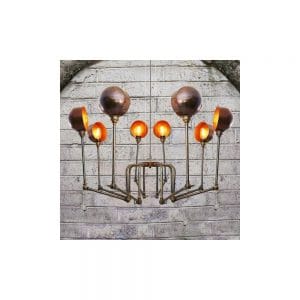
Monaghan – San Jose Industrial Chandelier
Chandeliers are multi light ceiling lights that add drama and interest to any setting. They are great at adding a wide spread of light over a large area. They are great used in a dramatic, dark dining or living rooms as they spread the light into the corners. They are also really effective used in hallways to enhance a glamorous welcome home and as a long drop over stairways. For added ambience, we would recommend teaming with a dimmer switch and dimmable bulbs to create the perfect light levels for all occasions.
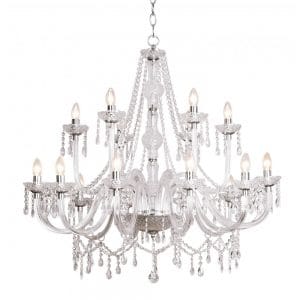
The Lighting Book – Katie 18 Light Large Chandelier
Semi-Flush and Flush Ceiling Lights:
Flush and Semi-Flush Ceiling Lights are great for homes with standard or low ceilings as they do not intrude into the room. These can vary dramatically in size and many have more than one bulb to ensure a bright light. There are a great selection featuring LED technology which will keep your running costs low but still wow your guests!!
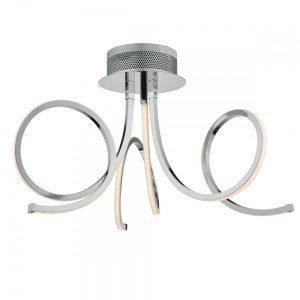
The Lighting Book – Tiro Semi Flush LED Chrome
Ceiling Pendants and Pendant Bars:
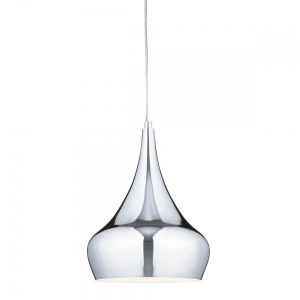
The Lighting Catelogue – Yurt; Gorgeous Highly Polished Chrome Ceiling Pendant
Ceiling Pendants are generally a single light suspended on cable, wire, flex or chain. They can be used in most rooms but most typically, we see these over breakfast bars, kitchen islands and dining tables. All styles are available, but generally the shape is a sleek design which concentrates a pool of light over the surface below. Obviously, the larger the diameter, the larger the pool of light. It is also worth considering the material of the light; if you like the style but it is to be the only light source in a larger room, you could look at one with a glass or translucent shade which allows the light to travel through, ensuring a wider spread of light. If you are using this over a table and are aiming for a more intimate effect, this would be achieved with metal or opaque shades. The shade inner is also important – if it is white, the light from your bulb will be brighter than if a warm copper or gold inner refracts the light for a cosy glow.
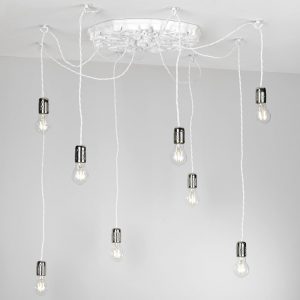
David Hunt Lighting – Chatsworth Decorative 8 Light Arctic White Pendant Cluster
Used in a cluster, they are a modern alternative to a chandelier and create a great interest to the room.
Ceiling bar pendants are a great way to utilise this popular style over larger areas, such as in the centre of kitchens and over longer dining tables.
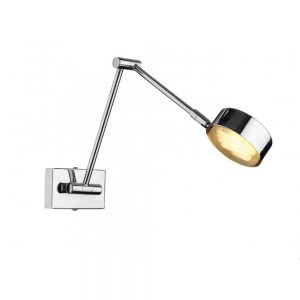
The Lighting Book – Cruise Adjustable Led Wall Reading Light
These are not to be underestimated when considering your lighting plan, as these really add to the ambience and overall effect in the room.
Picture and poster lights are particularly effective at drawing interest to your favourite works of art, or architectural interest.
Floor lamps are great at adding extra ambient light into a room and ensuring that there are no dark corners!
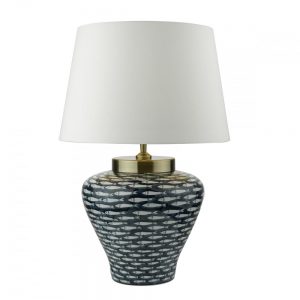
The Lighting Book – Joy Table Lamp
Table lamps offer interest to a room and offer a flexible light that you can move to suit any light requirement. Ceramic table lamps also double as artwork, offering the same decadent interest as a ceramic vase.
The Future of Lighting
The way we need to think about bulbs is to align their development and progress with that of home computing. It’s a constant evolution of concepts and ideas.
The next huge leap in lighting has already been developed and is starting to become available to us all. What could be better than an LED? The answer – the OLED (Organic Light Emitting Diode).
The OLEDs are innovative panels which offer unrivalled illumination whilst being less than 1cm thick. Samples are now being worked upon and are gaining in momentum as manufacturing methods are finessed.
OLEDs are currently the only technology that is capable of creating large areas of light and they can be made to be flexible, transparent and in a wide variety of colours. They are the closest light source developed to date, to natural daylight.
We will let you know the developments as they happen!