


Everything you need to know about bathroom lights.


In this article, we will cover all elements that you should consider when choosing bathroom lights. Whether it’s for a complete refurbishment or just replacing a broken light, you’ll feel well equipped to confidently make the right decision.
Although bathrooms are usually the smallest rooms in your home, they are usually one of the most expensive to change! It’s therefore vital that when you’re redecorating your bathroom, you ensure that you have considered all necessary elements. Along with your furniture, fixtures, tiles and taps, your bathroom lighting is a key consideration. More changes at a later date can require costly and time consuming redecoration.
Bathroom Lighting Explored
Types of Bathroom Lights:
- IP ratings; some countries do not have these level indicators, only a guide as to situations each light could be used in
- Power supplies can vary. The UK standard voltage is 230V, whereas in the USA it is 110V.
- Lampholders will vary, so buying replacement bulbs for a light purchased outside the UK would be problematic.
- UK lighting needs to conform to CE requirements. All of the lights from Lighting and Lights will be CE certified and marked for your peace of mind.
- The Frame; the main frame secured between the joists
- The Housing; a cylindrical housing, in a ‘can’ shape, which houses the bulb and electrics, hiding them from view in the ceiling
- The Trim; the visible part of the fixture, generally a round trim which surrounds the bulb or LED lit surface.
- Insulation Compatible (IC): ensures that it’s safe for the housing to be contact with insulation – this is important, as if you don’t use this when insulation is present, it is a potential fire risk. They are ideal used in ceilings that lead to an unfinished loft space.
- Non IC: these will need a protective cover that prevents the insulation layer from getting closer than 7.5cm to the housing. These are ideal used in a ceiling where there are finished floors above the ceiling they’re being fitting in.
- Airtight (AT): are ideal for use on a top floor, or ceiling that is directly beneath the roof. These keep warm air emitted from the bulb from flowing through the fitting and direct out of the roof.
Are bathroom lights different to normal lights?
Bathroom lighting does differ from lights that we use in every other room in the home. The reason for this is that the electrical components need to be protected from splashes and steam.
If water was to get into a light fitting, there is a very high chance that it could electrocute you. If a light gets wet that falls below IP44, handle with utmost care – we also recommend that it should be disposed of.
What does IP rating mean?
IP rating is a system which allows us to easily identify the level of protection the electrical components within our lighting has against solid particles and water.
Summarised with 2 figures, the first relates to dust or solid particles and dust. The second figure relates to the water and steam protection.
The below chart summarises the IP ratings; anything in blue would be useful in bathroom zones 1, 2 and 3 in a bathroom.


Therefore, bathroom lights should be a minimum of IP44 rated to be used safely in bathrooms, en-suites and cloakrooms.
What are bathroom zones when it comes to lighting?
Bathroom zones are a way of segmenting the likelihood that water could enter the electrics of a light.
Bathroom zone 0 would be an area where special submersible lights were used. For these lights, we’d recommend speaking to a specialist electrician, or a swimming pool light supplier.
The rest of the bathroom falls under IP44.


Bathroom zones one and two are areas where splashes are likely to occur.
Some lighting retailers will advise that the outside zone (also known as zone 3) could have a non-IP rated light. We always advise a minimum of IP44 in these areas too; if you have tried bathing children or pets, it will be obvious why!
What are UK bathroom lighting regulations?
The UK has stringent legislation regulations with regard to lighting which Lighting and Lights understands and adheres to. The legislation can differ from other parts of the world, so you may not be able to have a similar light to one you saw in your swanky hotel bathroom abroad.
Where we can differ:


Can you get double insulated bathroom lights?
You can get lights that are double insulated and IP rated for safe use in bathrooms.
Double insulated lights are designed with an extra insulation for safe use in homes without an earth cable. We have a useful blog on describing what these lights are – and to help you identify whether you need one. Read more about double insulated lighting.


Bathroom Light Types
Flush Bathroom Ceiling Lights
Bathroom Flush Fittings are designed for bathrooms with standard or low ceiling heights.
They are generally quite simple in design and shape, perfect for not snagging on the inevitable towels being swung around.


Bathroom Chandeliers
Bathroom Chandeliers are ideal to add a luxurious element to a bathroom. Over recent years, we have seen bathrooms shift from being purely functional, to being spaces where we choose to relax and have some quality time.


These can vary from being flush for short ceilings, to long hanging lights which are perfect for bathrooms with high ceilings and everything in between. There’s a handy chart to show the ideal drop for your height of ceiling.


N.B. Please note that if your ceiling is lower than 3 meters (9 feet, 11 inches), then it would drop into zone 1, therefore IP44 would be the minimum rated required for your lights.
Bathroom Ceiling Pendants
A modern concept in lighting for bathrooms, is the bathroom ceiling pendant.
Ceiling pendants are a firm favourite in lighting our homes, so it was only a matter of time before we adopted this look in our bathrooms.
A variety of styles are available to suit traditional or modern bathrooms and they bring a focal point to bathrooms with higher ceilings. They also add character, working well hung in rows over a countertop or shelves, or as an alternative to a wall light, either side of a mirror.


Bathroom Wall Lights
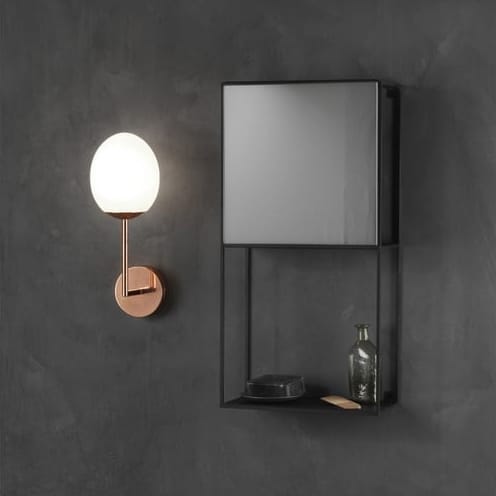
Wall lights in bathrooms (sometimes referred to as bathroom wall sconces) are a clear win but must be considered before you start placing your tiles!
Wall lights placed either side of a mirror work really well, as they help to illuminate the mirror without causing any glare.
They are also perfect for helping to choose the perfect light levels when they are individually switched. Normally, the switch used on switched bathroom wall lights is a pull cord. You can choose to use them alone (perfect for a softer light to have a relaxing soak in the bath!), with the ceiling light to maximise light output (perfect for make-up application, or shaving), or just the ceiling light (ideal for a quick shower before bed).
TIP – If you can, place your mirror opposite or near to the window as this will help to spread the natural light around the room when it’s daylight.


Bathroom Mirror Lights
Everyone needs a bathroom mirror, so what better way to add a bit of light to your bathroom than having a bathroom mirror light?
The one below also has the added benefit of a Bluetooth speaker, so you can soothe away the stresses of the day…

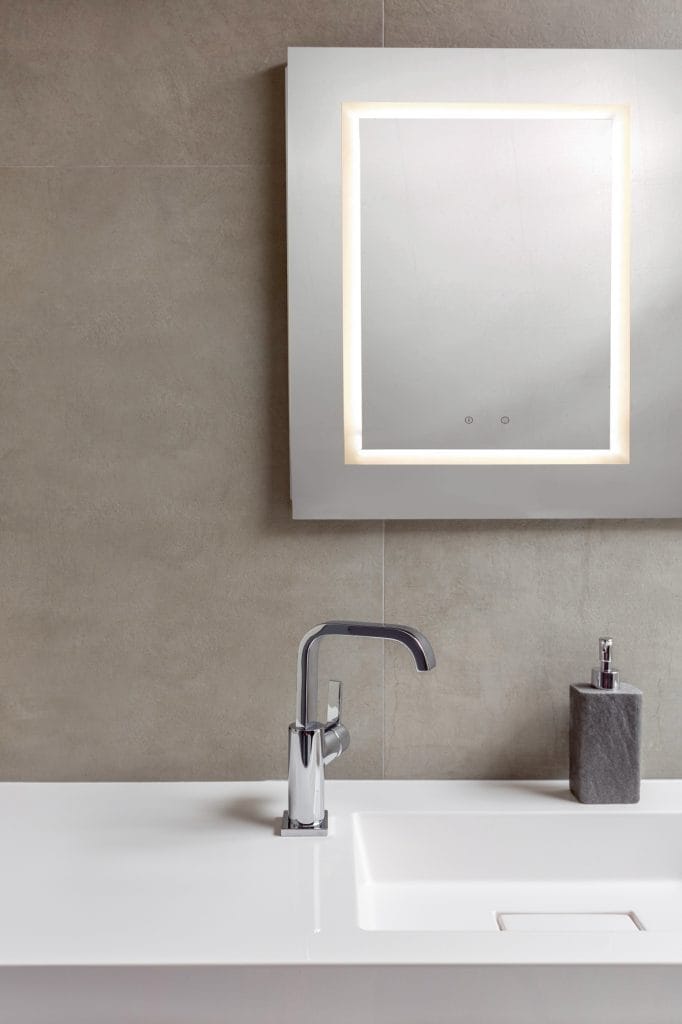
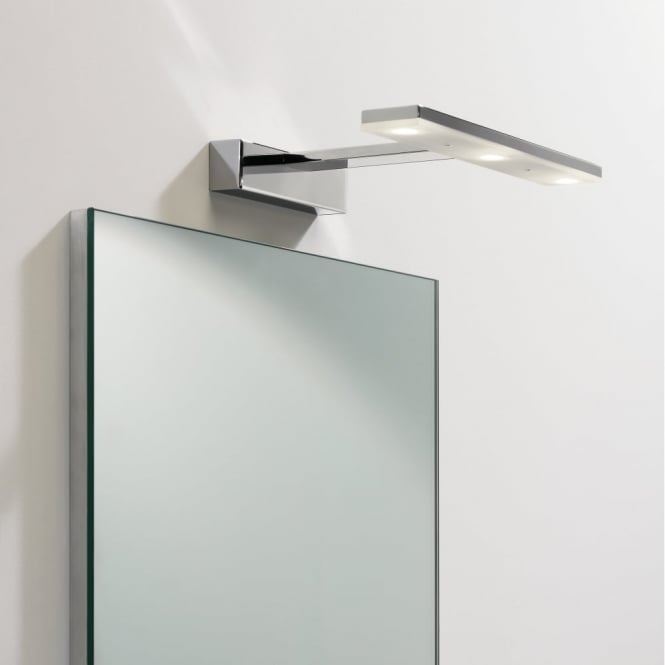
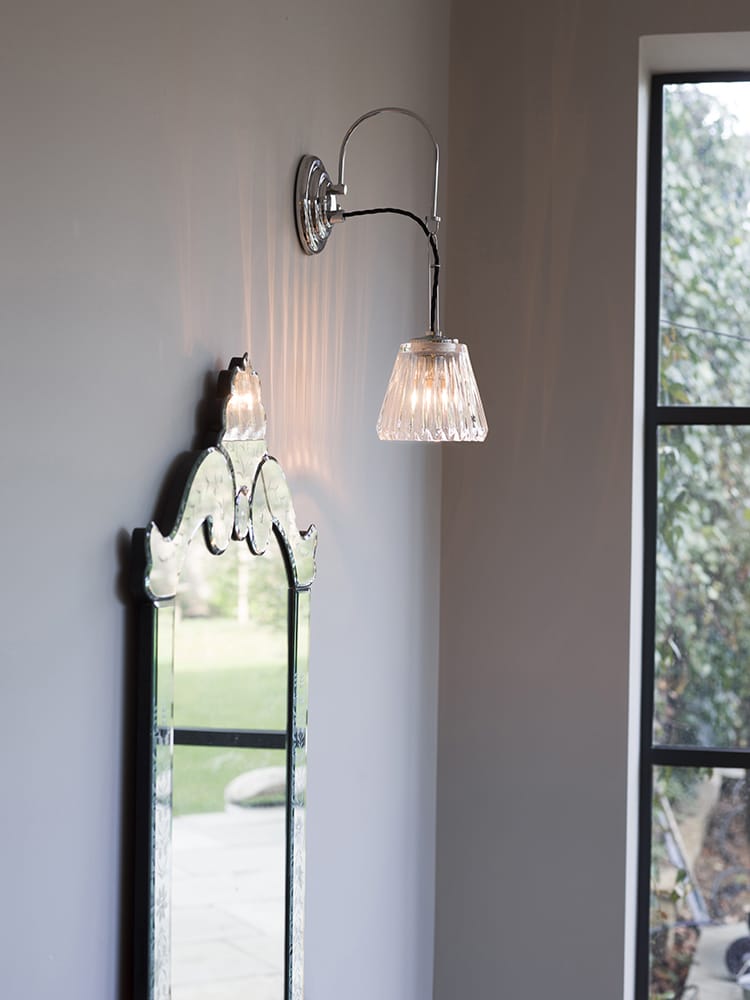
You can choose a sleek look, similar to a picture light, or you can choose one with a little more sparkle!
Recessed Bathroom Spot Lights
Recessed bathroom spotlights are great for a sleek, modern look. They are mounted into the ceiling and provide a wide spread of light into a room. Sometimes referred to as can lighting, or downlights, they are easy to team with other types of light. There are some considerations you’ll need to know before your opt for this style of lighting for your bathroom.
Recessed downlights consists of three parts:
You will need to contact an electrician to fit the spotlights and ensure that you have the correct type of fitting.
In addition, you’ll still need to ensure that they have the correct IP44 rating, or above.

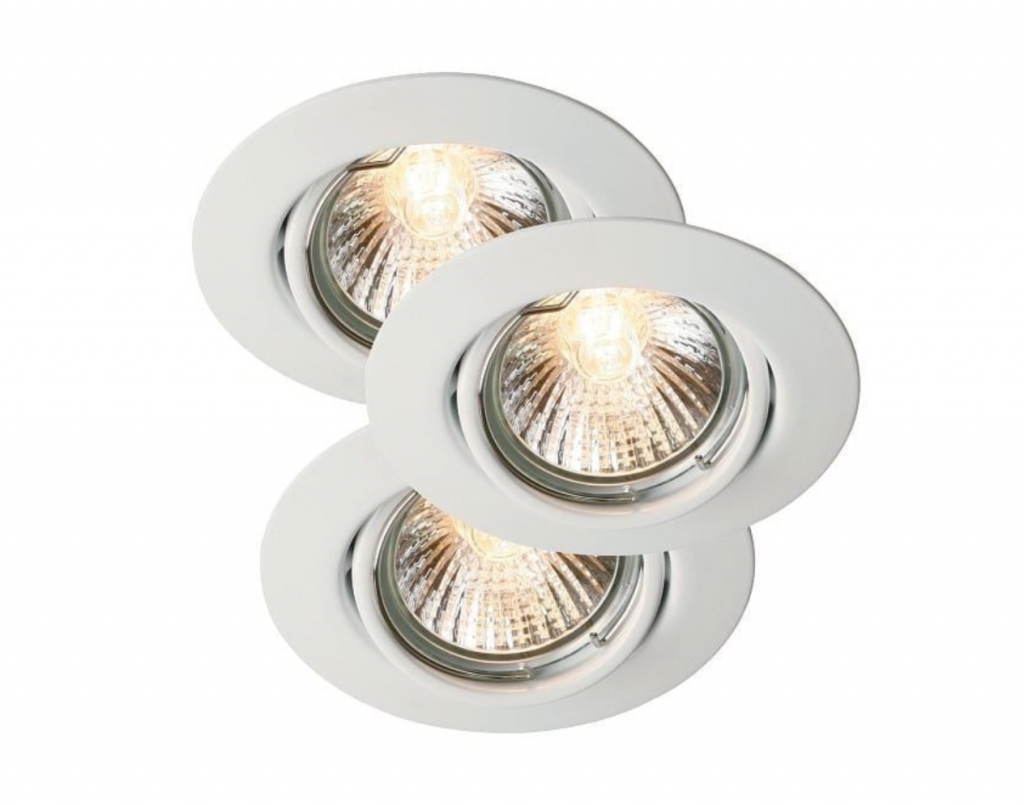
Another consideration is how many recessed spotlights you will need in your bathroom.
As a general rule of thumb, you will need to measure the height of your ceiling, and your spot lights should be positioned at half this measurement apart. For example, if your ceiling is 7 feet high, then your recessed spotlights should be spaced approximately 3 and a half feet apart.
TIP – try and avoid having a spotlight directly over a mirror. Shining down directly on top of your head can create shadows!
Surface Mounted Bathroom Spot Lights
If you like the idea of recessed spotlights in your bathroom, but don’t want to carve holes in your ceiling, you could consider surface mounted spot lights.


Energy Saving Bathroom Lights with Integral LEDs
LEDs are the present and future of lighting, yet there is still some nervousness surrounding them. Check out our myth buster below!
| Myth | Truth |
| When an integral LED is finished, you’ll have to throw away the light fitting. | Whilst this is true, most integral LEDs are designed to last between 15 and 25 years. How many light fittings have you got that are that old in your home now? |
| LEDs produce too much light. | Being at least 75% more efficient does not make them brighter. There’s a huge option of lumens and colour temperature on offer; many are now dimmable too! |
| LEDs need time to warm up | They don’t! They come straight on with their optimum light output and are ready for illumination. |
What size light do I need in my bathroom?
Getting the right size bathroom ceiling light is something that will really pay off.
Fortunately, this is the same equation as getting the right sized light in any other room in the home.
The calculation to determine the right size of light for your room size is shown below. This can be increased or decreased within 10% depending on your personal taste.
Width x Length = Diameter or Width of your light
You’ll need to use feet and inches! But, if you work best in metres, we have put together a handy chart below.


How much light do I need in my bathroom?
How much light you need in bathrooms is easy to guide, but you need to have a think about how you want to use the space.
Having enough light is really important when you need it, so below you can see an easy to read chart about how many lumens you should consider. This is to be spread across how many lights you choose to have.
If you like to relax in the bath, you may want to consider using dimmable bathroom lights.


If you still have any questions about which light you should choose, our staff are knowledgeable and friendly. Just email us or give us a call. We know how difficult it can be buying on-line. We can provide you with any information you need to help you confidently make your purchase.